
Oil standards · technical report
What is the API standard? Reading SQ, SP and CK-4 correctly
The “donut”, Starburst and Shield; S categories for petrol engines, C and F for diesel - updated for API SQ, ILSAC GF-7 and the CL-4/FB-4 roadmap.
Ung Vuong editorial teamPublished 18 Oct 2026Updated 13 Nov 20264 min read
The API (American Petroleum Institute) runs the Engine Oil Licensing and Certification System (EOLCS), described in API 1509 (23rd edition, February 2025). It is a voluntary programme: the oil company registers, the oil must pass the test set for its category, and only then may the API marks appear on the pack. An API category tells you which requirements the oil meets - not whether its viscosity suits your vehicle.
API's three marks
- The “donut” (API Service Symbol): the top half shows the service category (e.g. SQ, CK-4), the centre the SAE viscosity grade, and the bottom half may say “Resource Conserving” if the oil meets fuel-economy requirements.
- The “Starburst”: passenger-car oils meeting the current ILSAC standard (now GF-7A).
- The “Shield”: for oils meeting ILSAC GF-7B, which applies only to SAE 0W-16.
S categories: petrol engines
S stands for spark-ignition engines. The further the second letter is along the alphabet, the newer the category. Under API 1509, each newer category may be used where an older category in the same series is recommended.
| Category | For oils from | Notes |
|---|---|---|
| SQ | 2025 | May appear in the donut from 31 March 2025; adds protection against low-speed pre-ignition (LSPI) in fresh and aged oil, and against timing-chain wear |
| SP | 2020 | Added LSPI and timing-chain wear requirements over SN |
| SN | 2011 | Still licensable |
| SM | 2004 | Still licensable |
| SL | 2001 | Common on motorcycle oils |
| SJ | 1996 | Oldest S category still licensable |
ILSAC GF-7: Starburst and Shield
On the same date, 31 March 2025, licensing began for ILSAC GF-7, comprising GF-7A (for grades such as 0W-20, 5W-20, 0W-30, 5W-30 and 10W-30, carrying the Starburst) and GF-7B (0W-16 only, carrying the Shield). An API SQ oil with “Resource Conserving” corresponds to GF-7A. GF-6 is being phased out; products marked GF-6A may still be on shelves during the transition.
C and F categories: diesel engines
C stands for diesel (compression-ignition) engines. API CK-4 (for 2017 model-year engines) exceeds CJ-4, CI-4 and CH-4 and can be used in engines calling for them. API FA-4 is a separate series: xW-30 oils with an of only 2.9-3.2 cP to cut greenhouse-gas emissions. They are not backward compatible with CK-4 and older categories and are not recommended with fuel above 15 ppm sulfur - use them only where the engine manufacturer allows.
The next generation (PC-12) was approved by API in 2026 with two new categories: CL-4 (succeeding CK-4) and FB-4 (succeeding FA-4). The first licensing date is 1 January 2027, so at the time of this update no product can validly carry CL-4 or FB-4 on its label.
Label examples
A truck oil marked “API CK-4/SN” is primarily a diesel oil that also meets the SN petrol category - API 1509 puts the primary category first. Motorcycle oils usually show an S category (e.g. SL or SP) together with a JASO box: the S category describes general engine-oil quality, while JASO tells you whether the oil suits a wet clutch. If a bottle says only “API SN/CF” without the donut symbol, ask the seller for the technical data sheet: only API-licensed oils may carry the symbol.
References
Author
The content team of Ung Vuong Lubricants. Articles are compiled from brands' technical data sheets (TDS) and the SAE, API, ACEA and JASO standards; every article lists its references at the end.
For reference only - always check your vehicle manufacturer's handbook.
Products in this article
 Cars
 TrucksTDS
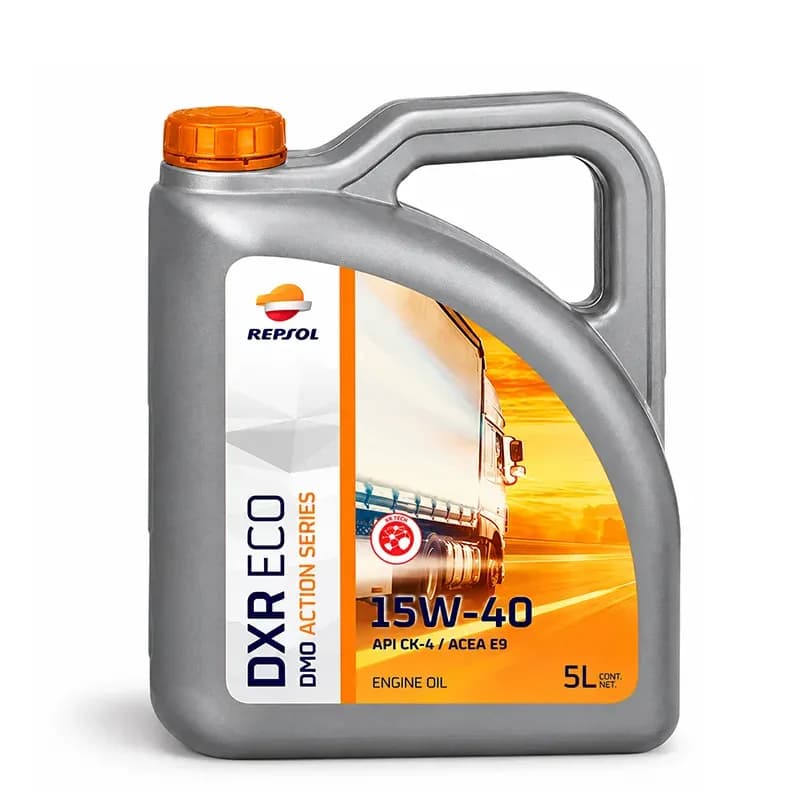
REPSOL DXR ECO SAE 15W‑40
- SAE 15W-40
- API CK-4
- +1
- +2
Read next
More articles
LONGFORMOil standards
JASO M355: DH-2, DL-1 and why Japanese diesels have their own standard
10 min read


Try it
Open the SAE J300 bench
Pick a grade and see what each number means.